Bella was very sick on Sunday, throwing up many, many times. She was lethargic all day and most of Monday with horrible diarrhea, but no more vomiting. Tuesday, she was a tad spunkier, but still not normal and her stools, liquid. Into the vet we went and left, one hefty bill later, with drugs to treat pancreatitis. Blood was taken to verify, but the vet felt all her symptoms pointed in that direction and she wanted to get on top of it immediately. Bella had eaten bird suet as evidenced by all the seeds that run through her and the vet felt the richness of the suet might have precipitated pancreatitis.
The results came back today. Nope. Not the big "P" which I am very happy to report! However, she does have coccidiosis which is common in puppies, but not in older dogs. (Does a three year-old lab mix still constitute a puppy?) Bella's intestines seem quite susceptible to parasites. Many of our vet visits have been because of something she consumed.
So it is back to the vet we go for more drugs, this time Albon (sulfadimethoxine). She is already taking Metronidazole, Sucralfate, and Proviable not to mention several days of canned Hill's Prescription I/D for gastrointestinal fortification! In 24 hours, her improvement has been remarkable.

October 31, 2012


October 30, 2012
Are YOU Ready?
With Hurricane Sandy wrecking havoc on the east coast of the US, it isn't surprising to see a glut of information about what to do with your pet(s) if you have to evacuate. This is a reminder for me also as I have a traveling bag for Bella, but still lack a crate.
My excuse? She's a big girl and needs a big crate—where would I store it? But when an emergency happens (and there is no area in this country that isn't plagued by recurring natural disasters), you won't have the time to prepare, nor can you guarantee you'll be thinking logically in a panic situation. Being prepared is the only way to safely care for your pet in a time of need. Although Hurricane Katrina was a turning point in evacuating and sheltering with pets (more shelters now allow them to come with you), you are still required to have your dog sequestered in a crate.
I just read Pet Care During a Natural Disaster from the Sun Gazette.com. I always read these articles as there is usually something I haven't considered. In this article, author Dan Boyles, had a couple of really good ideas. One is to have two bags prepared: a large pet bag if you and your pet will be staying together at a known location and a smaller bag for immediate evacuation to points unknown. Of course the requisite items were covered: food, water, medications, toys. Another great idea is to have a picture of you and your dog together. I always carry a picture of Bella in her bag, but the author says a picture of you together helps corroborate ownership should you be separated.
I guess it's time to start scouring Craig's List for used, large dog crates. I don't want Bella left out in the cold if a disaster shakes our area.
My excuse? She's a big girl and needs a big crate—where would I store it? But when an emergency happens (and there is no area in this country that isn't plagued by recurring natural disasters), you won't have the time to prepare, nor can you guarantee you'll be thinking logically in a panic situation. Being prepared is the only way to safely care for your pet in a time of need. Although Hurricane Katrina was a turning point in evacuating and sheltering with pets (more shelters now allow them to come with you), you are still required to have your dog sequestered in a crate.
I just read Pet Care During a Natural Disaster from the Sun Gazette.com. I always read these articles as there is usually something I haven't considered. In this article, author Dan Boyles, had a couple of really good ideas. One is to have two bags prepared: a large pet bag if you and your pet will be staying together at a known location and a smaller bag for immediate evacuation to points unknown. Of course the requisite items were covered: food, water, medications, toys. Another great idea is to have a picture of you and your dog together. I always carry a picture of Bella in her bag, but the author says a picture of you together helps corroborate ownership should you be separated.
I guess it's time to start scouring Craig's List for used, large dog crates. I don't want Bella left out in the cold if a disaster shakes our area.
October 29, 2012
Military Dogs Part 2
Once again military dogs are in the news. I am glad they are getting continued recognition for the part they play in the safety of our troops. It also corroborates the roll dogs have always played in our lives as part of a working team whether it's hunting, herding, protecting, aiding or just being there for us.
In this article, they tell of two men and their dogs, following their course. In one, the dog loses his partner and is currently being retrained with another. Considering the intensity of the work and trust in their partner (and here it could be either way—man to dog or dog to man), it is no wonder the transfer to a new trainer would be difficult for the dog. The second soldier loses his bomb-sniffing dog to a bomb, the loss devastating.
With your own dogs, in day-to-day life, think how intense the relationship is. The quirks, frustrations, trust, joy, training, bonding are all integral parts of the whole relationship. Then add a life and death situation. My heart goes out to the soldiers and the dogs who have lost their closest companion.
October 27, 2012
Military Dogs
And so as not to forget all the dogs serving bravely—medaled or not—please take a look at this great website: Rebecca's War Dog of the Week. There are many heroes and heroines here!
October 25, 2012
Medal of Honor
I knew animals, on occasion, received a Medal of Honor for bravery, but hadn't heard anything regarding this in a while. Today I came across an article about a spaniel mix, Theo, who was recently awarded, posthumously, Britain's highest award for animal bravery. The Dickin Medal. (The medal is named after Mary Elizabeth Dickin (1870-1951) who was a pioneer in animal welfare advocacy. She founded PDSA—the People's Dispensary for Sick Animals—to aide sick and injured animals owned by the poor.) Here is a picture of Theo.
This medal was first awarded in 1943 and continues to this day. Lots of pigeons have been awarded which I think is rather nice (also horses and a cat). But the nicest part is that animals are being recognized for the important, strategic part they play in keeping us safe.
This medal was first awarded in 1943 and continues to this day. Lots of pigeons have been awarded which I think is rather nice (also horses and a cat). But the nicest part is that animals are being recognized for the important, strategic part they play in keeping us safe.
September 12, 2012
Oops!
In an attempt to add labels to posts to make it easier to find like-minded topics, I realize the order of the posts has become quite jumbled. Arg! I apologize for making sequential reading impossible! I think the error probably resides in the way I did it. So sorry!
September 11, 2012
Losing a Friend
A friend has a 10-year old lab whom Bella adores. Amber was a young pup when she befriended my previous dog, Lucy, and Bella and Amber have a similar relationship. Bella LOVES Amber. Amber thinks Bella is special, but sometimes a pain in the neck. TOO MUCH ENERGY! But each time they see each other, it's joyous for both of them.
Amber was recently diagnosed with Mast Cell Tumors. These are common skin tumors that can pop up anywhere, at any time and for Amber, this has been the case. Her owner has tried an experimental chemo therapy treatment that eradicated a set of tumors, but new tumors appeared in other locations. The new regime is a daily chemo pill and my friend says the only indication she has that Amber may not be feeling well is she seems a bit more tired. Whether this is factual or my friend is super sensitive is moot.
We haven't allowed the dogs together since the diagnosis as we were both concerned Bella's exuberance to see Amber might be too overwhelming for the old girl. But now, knowing Amber seems to be feeling okay, I want the dogs together for both of their sakes.
Low and behold, as the universe always provides, Patricia McConnell's recent two-part blog entry speaks to dealing with a dog's grief. I have never had more than one dog at a time, but I know from my sister that dogs most definitely grieve. She had two lab mixes and though one was substantially larger, he was definitely not the boss. When his "sister" died, Amos went into a long a profound grief, expressed by lack of energy and enthusiasm; no desire to eat; no inclination to interact. My sister said one day she was walking Amos when ahead of them appeared a black lab that looked like his old compatriot. For the first time in weeks, his ears perked, his tail went up, he picked up his step to get closer, but on a single sniff, his ears and tail drooped and he turned away.
I believe animals do grieve. I want Bella to be able to spend time with Amber while she is still here, and luckily my friend agrees.
August 17, 2012
Tricks & Commands
Our weather has been inordinately cold. For a full week, day time temperature have not cracked freezing. Even the office, which is normally the warmest room in the house because of the heat generated by the computer, is cold. It's sunny and beautiful outside, but I just don't have the clothes to stay comfortably warm outside for very long. This creates a puppy occupational hazard.
To combat bored puppy syndrome, I decided to work with her on different tricks and commands. There are two I'm concentrating on at present. The first is the command "out" so that whatever she has in her mouth she spits out. She is actually pretty good about it, but I want it to happen instantly. If Bella has something she really loves (her tennis ball) or something she really wants (food) in her mouth, spitting it out won't happen immediately. In the case of food, I may have to "dig" it out. Here's a great video showing an example. Now if I can get Bella to do it as quickly as Pip, I'm in luck!
The trick we're presently undertaking is weaving between my legs. At this point, with luring, she's doing great. Luring means you walk a dog incrementally through the steps by having them follow food or a toy. The holdup is our ability (or lack thereof) to maneuver our hands and treats effortlessly to get Bella moving smoothly. (We are finding ourselves not quite agile enough!) This will be great for later if I choose to take her through agility. Basically, you hold food between your legs with the dog facing you. Guide the dog in between your legs, sweeping your arm around the back side of your leg to the front. Transfer the treat quickly to the other hand and guide her through and around the other leg. Here's a good video showing the technique. Eventually we'll stop luring and work with hand gestures.
These are as good for Bella as they are for us and as always, if done correctly, she’s learning and mentally stimulated and we’re bonding. Gotta love that!
To combat bored puppy syndrome, I decided to work with her on different tricks and commands. There are two I'm concentrating on at present. The first is the command "out" so that whatever she has in her mouth she spits out. She is actually pretty good about it, but I want it to happen instantly. If Bella has something she really loves (her tennis ball) or something she really wants (food) in her mouth, spitting it out won't happen immediately. In the case of food, I may have to "dig" it out. Here's a great video showing an example. Now if I can get Bella to do it as quickly as Pip, I'm in luck!
The trick we're presently undertaking is weaving between my legs. At this point, with luring, she's doing great. Luring means you walk a dog incrementally through the steps by having them follow food or a toy. The holdup is our ability (or lack thereof) to maneuver our hands and treats effortlessly to get Bella moving smoothly. (We are finding ourselves not quite agile enough!) This will be great for later if I choose to take her through agility. Basically, you hold food between your legs with the dog facing you. Guide the dog in between your legs, sweeping your arm around the back side of your leg to the front. Transfer the treat quickly to the other hand and guide her through and around the other leg. Here's a good video showing the technique. Eventually we'll stop luring and work with hand gestures.
These are as good for Bella as they are for us and as always, if done correctly, she’s learning and mentally stimulated and we’re bonding. Gotta love that!
Quick Toothy Update
Bella was slowed down for several days post surgery. She didn't seem to mind the absence of toys...until two days ago and then it was a battle to keep things out of her mouth. No toys were available, but she raided our backyard wood pile several times and ran south, happily crunching through a plastic plant pot I was about to wash from transplanting veggies to a bigger container.
To keep the both of us sane, I decided it was time to ease dry food back into her diet and began reintroducing toys. None of her harder toys are available, but anything that is soft-edged is back in her toy basket. Her biggest joy? Her very-most-highly-obnoxious Good Cuz squeaky toy. This toy (she has two—I don't know what possessed me) has an awful, high-pitched squeak that she goes crazy over. She immediately de-limbed both of them which makes their bounce even more erratic (another selling point for Bella). We only allow her to have it for a couple of days as my husband and I turn into loonies from all the squeaking.
It is a joy to see her so happily jaw-boning again. You just can't keep a good chewer down!
To keep the both of us sane, I decided it was time to ease dry food back into her diet and began reintroducing toys. None of her harder toys are available, but anything that is soft-edged is back in her toy basket. Her biggest joy? Her very-most-highly-obnoxious Good Cuz squeaky toy. This toy (she has two—I don't know what possessed me) has an awful, high-pitched squeak that she goes crazy over. She immediately de-limbed both of them which makes their bounce even more erratic (another selling point for Bella). We only allow her to have it for a couple of days as my husband and I turn into loonies from all the squeaking.
It is a joy to see her so happily jaw-boning again. You just can't keep a good chewer down!
August 9, 2012
Dogs versus Drugs

Anyone who truly loves their dog understands the benefit dogs provide for stress and healing. Growing up, my mother's mother lived with us after my father passed away. When my grandmother died at the ripe, old age of 103, we knew my mother would make it through her grief more easily because of her dog. When her dog died, our concern went way up. I don't mean that losing her mother wasn't traumatic; her mother, my grandmother, was one of the most wonderful people I know. But my siblings and I knew that being able to pat her dog's head, kiss her ears and rub her belly would be the best "medicine" my mom could have.
Dogs, beyond family pets, have many different jobs—entertainers (movies, dock divers, etc.), sniffers (bombs, drugs, disease, etc.), helpers (disabled, blind, and so on) and now on another field, for soldiers suffering from Post Traumatic Stress Disorder (PTSD). A program, Paws for Purple Hearts, was started in California in 2006, to offer "therapeutic intervention for veterans and active-duty military personnel by teaching those with Post-Traumatic Stress Disorder (PTSD) to train service dogs for their comrades with combat-related physical disabilities."
The animals draw out even the most isolated personality, and having to praise the animals helps traumatized veterans overcome emotional numbness. Teaching the dogs service commands develops a patient’s ability to communicate, to be assertive but not aggressive, a distinction some struggle with. The dogs can also assuage the hypervigilance common in vets with PTSD. Some participants report they finally got some sleep knowing that a naturally alert soul was standing watch.
There is a petition available to sign asking the U.S. Senate to provide service dogs to vets with PTSD. Now that's good medicine! (I don't know if this was something incorporated into HR 1627 or is separate.)
PAWPRINT: Here is a lovely story about a vet suffering from PTSD who was reunited with the dog he worked with in Iraq.
PAWPRINT 2: Using dogs to aide soldiers is a big deal right now. Just recently the U.S. Senate passed bill HR 1627 that helps with some of the obstacles vets run into. Here's another story.
PAWPRINT 3: This post just isn't going away. I came across this article today (10/18/2012)on a military dog with PTSD. Luckily it found a good, supportive home. Now if we could just honor and care for all men, women and dogs suffering from this...
-----------------
UPDATE: This bit of news just came through our paper today.n The VA (Veterans Affairs) will no longer pay for service dogs for vets with mental disabilities such as PTSD.
August 4, 2012
Hiking!
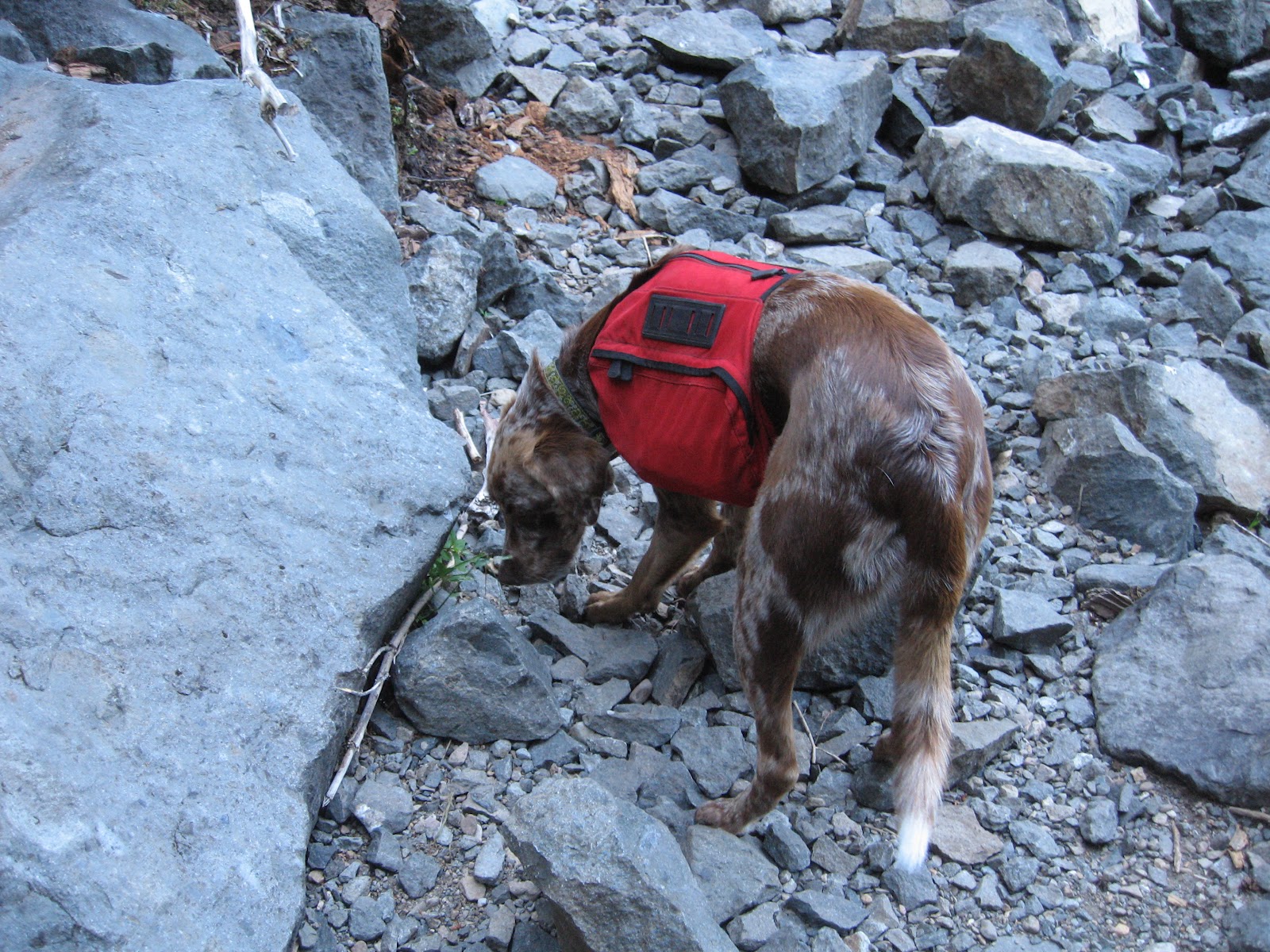
I bought a new day pack for myself after 20 years of using a bomb-proof school back pack. I can't throw the old pack out...it really is impervious to wear and tear...but I can't get all I need into it. The new pack is a dream (Gregory Jade 28)—light weight, nice-sized compartments, and comfortable to wear. The purchase was prompted by my desire to do more hiking alone and therefore needing to carry more things for safety. I dug out Lucy's old dog pack and with some tweaking, it fits Bella! Huzzah! She can carry her own water!
The last two weekends have been gorgeous and provided the perfect weather for an outing.
I've noticed hiking alone with Bella makes her far more attentive to where I am than if we are with others. I think this is because she doesn't hear me talking, so is constantly stopping and waiting for me. I love this! Good dog, Bella!
I am also aware that if I follow her route through an iffy bit of trail, she invariably picks the easiest path. A third plus is though I am directionally challenged (I never hike without a compass and map), if I'm back-tracking and come to a confusing trail intersection, I wait for her to pick "our" trail. She's never wrong. With last girl-dog, Lucy, none of this was the case—not to mention a whistling marmot was her siren song to leap into the unknown and give chase. Not Ms. Bell. She stays close and on the trail.
Bella also prefers not to drink from a bowl, but directly from the water bottle. Also a plus! One less thing to carry! She is very good at capturing the dribble and wastes little, which was great for today's hike. The trail had excellent water flow in June when I hiked it with a friend, but next to none today.
I'm hoping we can get several more hikes under our belt before we head out with a friend for a several day back-packing adventure mid-fall. It's been many years since I've "over-nighted" and want to make sure I have the stamina to carry more weight. I will continue to load the new pack until eventually moving over to my large pack carrying 35 or more pounds.
The last two weekends have been gorgeous and provided the perfect weather for an outing.
 |
| Heading to the gap above the center of a snow field. |
 | |||
| Sniffing who was here earlier. |
I've noticed hiking alone with Bella makes her far more attentive to where I am than if we are with others. I think this is because she doesn't hear me talking, so is constantly stopping and waiting for me. I love this! Good dog, Bella!
I am also aware that if I follow her route through an iffy bit of trail, she invariably picks the easiest path. A third plus is though I am directionally challenged (I never hike without a compass and map), if I'm back-tracking and come to a confusing trail intersection, I wait for her to pick "our" trail. She's never wrong. With last girl-dog, Lucy, none of this was the case—not to mention a whistling marmot was her siren song to leap into the unknown and give chase. Not Ms. Bell. She stays close and on the trail.
Bella also prefers not to drink from a bowl, but directly from the water bottle. Also a plus! One less thing to carry! She is very good at capturing the dribble and wastes little, which was great for today's hike. The trail had excellent water flow in June when I hiked it with a friend, but next to none today.
I'm hoping we can get several more hikes under our belt before we head out with a friend for a several day back-packing adventure mid-fall. It's been many years since I've "over-nighted" and want to make sure I have the stamina to carry more weight. I will continue to load the new pack until eventually moving over to my large pack carrying 35 or more pounds.
May 22, 2012
This is Not the End, Just a Temporary Leave of Absence
I know I've been silent, but it hasn't been that I haven't thought about writing. In fact, I think about it daily. But what I have discovered is that if I write here, I write no where else and writing only about Bella is not where I want my sole writing focus to flow...though Bella, herself, is pretty much front and center in my life (after my lovely soul mate, of course). So I've decided to take a breather so I can prioritize how and what I want to write about.
Dogs are a central part of my being and Bella has become my "heart" dog, which I thought impossible after Suzy. Lucy was my workout dog and to be honest, though I loved her, I don't ever want to repeat that relationship. It was too problematic and governed my life in a very non-positive way.
So how to write here and other places. How to write about dogs, my girl Bella, and keep things interesting, instructive and entertaining both for you, my dear reader, and for me. Hm. What makes a dog blog enticing to you? Are pictures more important than content? Would you read if there were few pictures? Things to ponder. Please let me know. I need to know if I am going to continue.
So without further adieu, I bid (I hope) a temporary adieu while I reconsider and reconstruct my writing priorities.
Dogs are a central part of my being and Bella has become my "heart" dog, which I thought impossible after Suzy. Lucy was my workout dog and to be honest, though I loved her, I don't ever want to repeat that relationship. It was too problematic and governed my life in a very non-positive way.
So how to write here and other places. How to write about dogs, my girl Bella, and keep things interesting, instructive and entertaining both for you, my dear reader, and for me. Hm. What makes a dog blog enticing to you? Are pictures more important than content? Would you read if there were few pictures? Things to ponder. Please let me know. I need to know if I am going to continue.
So without further adieu, I bid (I hope) a temporary adieu while I reconsider and reconstruct my writing priorities.
May 8, 2012
Dog Communication in a Nutshell
Here's a great doggie posture chart drawn by Lili Chin and posted on City Dog Country Dog facebook page. The chart is a cartoon, but definitely worth reviewing as it shows different postures that are worth knowing! I saw this first through Grisha Stewart's book on Behavior Adjustment Training (BAT) for aggressive dogs. Lili is a great illustrator!
Lili Chin Dog Postures
Lili Chin Dog Postures
April 30, 2012
What? Another Class?
This is the question I was asked the other day. Yep. Another class. This one is called "Clicks and Tricks" and it's offered at my favorite facility, Seattle Agility Center. I've found a wonderful instructor there (although they all are great.) Tawnya, the woman from whom I've taken several classes, said something that clicked at the end of our Rally class. I knew it intuitively, but I hadn't verbalized it. She said, "I'm glad you are taking Bella through more courses. It keeps her thinking and helps with your bond." I might add that it keeps me thinking also! I love working with Bella and enjoy learning more—and better—ways to do things with her.
I find this particular clicker class exhausting for both the B Girl and I. I am not adept at it yet (a little slow on the click and treat) and I'm sure this causes confusion with Bella, but we both like it and Tawnya is great. She drops little comments that are spot on and like all instructors, I'm sure she is thrilled when she sees a student "get it."
I am presently working on not using Bella's name as a correction. I think dogs are intelligent enough to get your tone of voice and know that their name said in "that" tone means they had better pay attention and toe the line. Yet I also understand Tawnya's advice that giving verbal instruction instead of just using the name as a correction is more positive and pro-active.
Bella and I are clicking our way through rolling over (so far she is merely laying down, no "over" so far), high five with both paws (my girl is definitely right-pawed), spin (check!), grabbing and retrieving a basket (she nudges it, but has not mouthed it yet).
I find this particular clicker class exhausting for both the B Girl and I. I am not adept at it yet (a little slow on the click and treat) and I'm sure this causes confusion with Bella, but we both like it and Tawnya is great. She drops little comments that are spot on and like all instructors, I'm sure she is thrilled when she sees a student "get it."
I am presently working on not using Bella's name as a correction. I think dogs are intelligent enough to get your tone of voice and know that their name said in "that" tone means they had better pay attention and toe the line. Yet I also understand Tawnya's advice that giving verbal instruction instead of just using the name as a correction is more positive and pro-active.
 |
| I'm ready! I'm ready! Whaddya want? High five? Spin? |
April 14, 2012
Old Fears
Lucy, our last dog, was attacked on three occasions by three different "packs" of pit bulls—always a gang of two. Although I don't blame the dogs (but the horribly negligent owners), I have an ingrained fear of pits because of those incidents. And it is the last attack where one dog took on Lucy's front and the other her rear that is seared into my brain.
So imagine my fear while walking Bella and K2 (whom I was caring for), when two pits rushed us. One backed off immediately, but not the other. K2 was at the end of her leash trying to distance herself while Bella was the target. The dog did not attack, but was growling, aggressive and kept his head over her shoulders. Bella's tail was tucked and in no mood to argue. I was trying to position myself between them (not smart), screaming and kicking at him while the owner was yelling and trying to grab him.
So imagine my fear while walking Bella and K2 (whom I was caring for), when two pits rushed us. One backed off immediately, but not the other. K2 was at the end of her leash trying to distance herself while Bella was the target. The dog did not attack, but was growling, aggressive and kept his head over her shoulders. Bella's tail was tucked and in no mood to argue. I was trying to position myself between them (not smart), screaming and kicking at him while the owner was yelling and trying to grab him.
When the owner was able to separate him, I told her she had better leash her dogs; she had no business allowing them loose. She told me to get off her property. Huh? I'm walking in the middle of a city street with two leashed and licensed dogs. This is public property, ma'am, and your dogs are loose and aggressive. Déjà vu. It was too scary to relive this kind of scenario with Bella. I have woken each morning since and that dog is the first thing that comes to mind.
April 4, 2012
Dealing with Injuries
When we were in Baja, Bella injured herself several times. Having your best buddy hurt is hard in any situation. Down there, it was doubly traumatic for me as we were so far from the "big city." Compound that by the day of the week (did we have to wait through the weekend?) and potential language snafus, and Bella being hurt became a big issue.
All her injuries were play/exuberance induced. Chasing a ball while not looking where she was going, she ran into the front of a parked car hitting it hard enough to visibly move it. I thought she'd dislocated her shoulder. Luckily, with a couple of anti-inflammatories under her belt and a few days of rest, she was fine. Best yet, she started looking where she was running!
Then she cut some pads on her back paws. We were told that the yard, all sand, had once been a neighborhood dumping spot. For two months I raked the yard daily, always uncovering shards of glass. I figured I pulled out over 20 pounds of glass, rusted nails and wires, broken pottery and other sharp objects—but most was glass. One pad was cut severely enough that I wondered if it would ever heal back to a normal shape. And what about infection? Luckily, infection didn't set in and her pads are fine!
This was followed by another injury where she stopped putting any weight on a back foot. (Her poor back paws!) There is a ubiquitous, little grass in Baja that several dog owners warned me about. Of course, it is most problematic when it dries because its color becomes even more sand-like. And like foxtail here, this grass can also kill. I looked at Bella's paw (which is also sand-colored) and found nothing. My husband did the same with a magnifying glass. We even tried to clip the fur which was tough as her fur is already short, but we found nothing. I wanted to take her to a vet in the city, but we had to wait until Monday—two days away.
Luckily for Bella and us, a neighbor was a retired veterinarian from the states. Although he wasn't interested in practicing anymore, he was willing to look at Bella. The way he did it was interesting. Where we went right to the source—her paw—he said he always starts further away. One, he wants to calm the animal, but also, the injury may actually be elsewhere. He started at her hip and worked his way down to her paw assessing leg movement as he went.
The vet looked both at the bottom and the top. Bingo! Looking at the whole foot from the top (not just between toes), you could see how swollen one toe was. He surmised she had probably sprained a toe and suggested we put her on anti-inflammatories for a couple of days. He said if there was any abscessing to let him know immediately as that could mean the grass seed was an issue. However, after several days she was fine.
On our drive back home in the states, late one night before bed, she jammed a stick into the back of her mouth, slicing skin open. Awful! Blood everywhere! I was frantic, but luckily we were back in the states and I knew we could get to a vet early in the morning.
All her injuries were from play though that doesn't make it any easier to deal with. But wonder if your pup is seriously hurt? Considering how I hate the sight of blood (fainting would not be too off the mark), how does one handle a pet's injuries?
I feel lucky that none of Bella's incurred injuries in Baja were life threatening. Quite a few years ago, I attended a Pet First Aid class put on by a local shelter. It was brief, but a good class; we each received a pet first aid booklet that I keep in Bella's traveling bag. Recently I learned that a neighbor teaches a more intensive pet first aid class and is trying to put together a local offering this spring, which I'd love to attend.
Today I received a link via Bark Magazine on how to deal with a bleeding pet. Because many of us take our dogs traveling and those dogs participate in many of our sports—hiking, mountain biking, skijoring, etc.—the chance of a pup getting hurt is not all that unlikely. I urge you to look into pet first aid classes offered in your community. It's a great feeling of security knowing you are better able to help an injured pet until you can get it to a veterinary hospital.
All her injuries were play/exuberance induced. Chasing a ball while not looking where she was going, she ran into the front of a parked car hitting it hard enough to visibly move it. I thought she'd dislocated her shoulder. Luckily, with a couple of anti-inflammatories under her belt and a few days of rest, she was fine. Best yet, she started looking where she was running!
Then she cut some pads on her back paws. We were told that the yard, all sand, had once been a neighborhood dumping spot. For two months I raked the yard daily, always uncovering shards of glass. I figured I pulled out over 20 pounds of glass, rusted nails and wires, broken pottery and other sharp objects—but most was glass. One pad was cut severely enough that I wondered if it would ever heal back to a normal shape. And what about infection? Luckily, infection didn't set in and her pads are fine!
This was followed by another injury where she stopped putting any weight on a back foot. (Her poor back paws!) There is a ubiquitous, little grass in Baja that several dog owners warned me about. Of course, it is most problematic when it dries because its color becomes even more sand-like. And like foxtail here, this grass can also kill. I looked at Bella's paw (which is also sand-colored) and found nothing. My husband did the same with a magnifying glass. We even tried to clip the fur which was tough as her fur is already short, but we found nothing. I wanted to take her to a vet in the city, but we had to wait until Monday—two days away.
Luckily for Bella and us, a neighbor was a retired veterinarian from the states. Although he wasn't interested in practicing anymore, he was willing to look at Bella. The way he did it was interesting. Where we went right to the source—her paw—he said he always starts further away. One, he wants to calm the animal, but also, the injury may actually be elsewhere. He started at her hip and worked his way down to her paw assessing leg movement as he went.
The vet looked both at the bottom and the top. Bingo! Looking at the whole foot from the top (not just between toes), you could see how swollen one toe was. He surmised she had probably sprained a toe and suggested we put her on anti-inflammatories for a couple of days. He said if there was any abscessing to let him know immediately as that could mean the grass seed was an issue. However, after several days she was fine.
On our drive back home in the states, late one night before bed, she jammed a stick into the back of her mouth, slicing skin open. Awful! Blood everywhere! I was frantic, but luckily we were back in the states and I knew we could get to a vet early in the morning.
All her injuries were from play though that doesn't make it any easier to deal with. But wonder if your pup is seriously hurt? Considering how I hate the sight of blood (fainting would not be too off the mark), how does one handle a pet's injuries?
I feel lucky that none of Bella's incurred injuries in Baja were life threatening. Quite a few years ago, I attended a Pet First Aid class put on by a local shelter. It was brief, but a good class; we each received a pet first aid booklet that I keep in Bella's traveling bag. Recently I learned that a neighbor teaches a more intensive pet first aid class and is trying to put together a local offering this spring, which I'd love to attend.
Today I received a link via Bark Magazine on how to deal with a bleeding pet. Because many of us take our dogs traveling and those dogs participate in many of our sports—hiking, mountain biking, skijoring, etc.—the chance of a pup getting hurt is not all that unlikely. I urge you to look into pet first aid classes offered in your community. It's a great feeling of security knowing you are better able to help an injured pet until you can get it to a veterinary hospital.
April 1, 2012
Choosing a Day Care for Your Pup
Some good friends recently adopted a young rescue dog. This pup is very lucky as she is with her pack 24/7. The owners are self-employed, so their new dog, K2, is at work with them all day. They are also quite active, so K2 gets to jog, hike or play daily, plus her owners set up play dates with neighborhood dogs. K2 arrived at their house with beautiful doggie etiquette and the ability to communicate well with her other four-legged friends. This pup doesn't need doggie day care, but we did discuss how valuable it can be. There are now so many available, the question is how do you choose the one that is most appropriate for your favorite four-legged friend?
I wrote about my experience with doggie day care when Bella was a young girl. My husband and I are retired so Bella is rarely alone, but I was concerned she wasn't getting enough time with other dogs. The first place I checked out, though less expensive and closer, didn't have a large enough people-to-dog ratio. It seemed a recipe for disaster. The place I ended up taking her I liked a lot, but with two exceptions: it was too far away and its policy for a mandatory four hour stay was inconvenient. Bella went once and that was it, although I would have continued if they were closer. She hasn't been back to a day care since.
However, if you are away from home for long stretches of time and your best buddy is on his own, doggie day care might be the perfect solution to relieve his boredom. Recently I've come across a series of articles on the Internet with guidelines for choosing day care that suits your wallet, peace of mind, and your pup's temperament. Bark Magazine has an excellent article and a great tip sheet that is definitely worth perusing if you are thinking of this activity for your pup. I feel the people-to-dog ratio is critical and Riverdog, where Bella went, was great with this—around 10-15 dogs to one person plus an office staff that was available should the need arise. In addition, they "matched" Bella's playing style with other dogs so she was neither overwhelming or overwhelmed. They also had "quiet time" interspersed in the four hour visit so dogs had an opportunity to cool their jets.
The different articles I read also encouraged prospective doggie day care-ites to watch the day care in action to see how activities and interactions are handled. If you are not allowed to observe, go elsewhere. (Many also have cameras in the rooms so you can watch how your pup is doing while you're at work.) If they have a breed exclusion policy—put on the brakes—it indicates misunderstanding the difference between behavior and breed. The facility should require all dogs be current on vaccinations, are in good health, are sociable and well-behaved. What is the training and knowledge of the staff working with your dog's group? How do they handle a medical emergency? Not all dogs are good candidates for day care. The energy level and commotion of multiple dogs running around may overwhelm your buddy. Obviously, finding the appropriate doggie day care for your pup is critical if you want your dog safe and happy!
Here are some other articles I liked:
Selecting a Dog Daycare
How to Choose a Doggie Daycare
Choosing Doggie Daycares and Kennels
Choosing a Good Dog Day Care
Good luck in your hunt; your pup will thank you for it!
I wrote about my experience with doggie day care when Bella was a young girl. My husband and I are retired so Bella is rarely alone, but I was concerned she wasn't getting enough time with other dogs. The first place I checked out, though less expensive and closer, didn't have a large enough people-to-dog ratio. It seemed a recipe for disaster. The place I ended up taking her I liked a lot, but with two exceptions: it was too far away and its policy for a mandatory four hour stay was inconvenient. Bella went once and that was it, although I would have continued if they were closer. She hasn't been back to a day care since.
However, if you are away from home for long stretches of time and your best buddy is on his own, doggie day care might be the perfect solution to relieve his boredom. Recently I've come across a series of articles on the Internet with guidelines for choosing day care that suits your wallet, peace of mind, and your pup's temperament. Bark Magazine has an excellent article and a great tip sheet that is definitely worth perusing if you are thinking of this activity for your pup. I feel the people-to-dog ratio is critical and Riverdog, where Bella went, was great with this—around 10-15 dogs to one person plus an office staff that was available should the need arise. In addition, they "matched" Bella's playing style with other dogs so she was neither overwhelming or overwhelmed. They also had "quiet time" interspersed in the four hour visit so dogs had an opportunity to cool their jets.
The different articles I read also encouraged prospective doggie day care-ites to watch the day care in action to see how activities and interactions are handled. If you are not allowed to observe, go elsewhere. (Many also have cameras in the rooms so you can watch how your pup is doing while you're at work.) If they have a breed exclusion policy—put on the brakes—it indicates misunderstanding the difference between behavior and breed. The facility should require all dogs be current on vaccinations, are in good health, are sociable and well-behaved. What is the training and knowledge of the staff working with your dog's group? How do they handle a medical emergency? Not all dogs are good candidates for day care. The energy level and commotion of multiple dogs running around may overwhelm your buddy. Obviously, finding the appropriate doggie day care for your pup is critical if you want your dog safe and happy!
Here are some other articles I liked:
Selecting a Dog Daycare
How to Choose a Doggie Daycare
Choosing Doggie Daycares and Kennels
Choosing a Good Dog Day Care
Good luck in your hunt; your pup will thank you for it!
March 23, 2012
Happiness is Digging in Sand


March 19, 2012
Food Again
 Anyone who has followed this blog knows that over the past year I've been poking my nose into improving Bella"s diet. I've researched raw and home-cooked until I'm more confused than ever. My final straw was a friend who remarked to my lamenting, "What's wrong? Is Bella sick? Is she not eating? Does she have allergies?" To which I could happily and honestly say, "No, she's fine; I'm just curious." This, of course, is why we have good friends because they cut to the quick. Her departing comment to the conversation was, "Why are you so worked up about it if buying good commercial kibble works?" How can you fight that argument?
But still, I was unsettled. Since we returned from Baja, Bella has had what I call a "bothersome butt." She licks it frequently. She's been on Trifexis since before we left. I've seen no evidence of worms in her stool, yet something is bothering her. She has always farted when she sat (a somewhat oddly charming personal trait of hers), but is doing more so now. If the bottom licking continues into next week, I'll take a stool sample into the vet, but until then, I've been focusing once again on her food.
When we hit the border coming back into the US, she was nearly out of food (Acana), so it was necessary to get more. I stopped at Costco to pick up some things for us and noticed they had a grain-free kibble and got that. But is it as good for her as Acana? I doubt it (though it is given 4 out of 5 stars by DogFoodAdvisor). To help with her "issues," I picked up a couple of cans of organic pureed pumpkin, thinking some extra fiber may help. And then came across some videos on choosing good food for your pup by Dr. Karen Becker, a holistic vet. I approached the videos a bit skeptically as she is affiliated with a site which sells products, but I was quite pleased that she doesn't promote any brand in these videos. The argument she made for raw that I found most compelling was that kibble is dry and dogs need around 70% moisture in their diet and they receive that from eating raw. My vet has said several times, despite Bella's huge water slurping consumption, that my favorite girl-dog is a bit dehydrated. Dr. Becker's comments along with my vet's persuaded me to get more serious about introducing raw food into Bella's menu. At this point I am not going 100% raw, but am certainly willing to incorporate it into her daily food regime—along with going back to Acana when her present kibble is gone.
Take a look at Dr. Becker's two videos and tell me what you think. Are you already feeding raw? What results have you seen in that food move? If you aren't presently feeding raw, are you toying with moving that way—and why?
Video 1: Choosing the Right Dog Food/Part 1
Video 2: Choosing the Right Dog Food/Part 2
March 16, 2012
Poisons, Breeds and Names
Oh my! I found a series of stories regarding common household poisons your dog might ingest, along with the most common name of said dog and most common breed called in for suspected poisoning. Bella is the most common name and a Lab is the second most common breed. Can't say I'm surprised on the latter. I remember chatting with a cashier after I purchased a sealable container to store Bellie's food. (This, of course, was after she ate nearly half a bag and had a stomach that did not return to its normal shape for days.) The cashier's Lab ate a Costco package of light bulbs leaving only the metal twist bottom behind. Unbelievably, her dog was fine. But having witnessed Bella's mouthy penchant, I know she will eat nearly anything if it entices her. (Think brillo pad.)
Here is a list of the most common household poisons (for 2011) your pup may ingest and what to do if you suspect poisoning. (It is from this article which carries more detail and is a good, if short, read):
Here is a list of the most common household poisons (for 2011) your pup may ingest and what to do if you suspect poisoning. (It is from this article which carries more detail and is a good, if short, read):
- People Food (think chocolate, raisins, etc.)
- Insecticides
- Rodenticides
- NSAIDs (Ibuprofen, Advil, etc.)
- Household Cleaners
- Human Drugs (anti-depressants)
- Garden Fertilizers
- Heavy Metals
- Acetaminophen
- Veterinary Pain Relievers
Subscribe to:
Posts (Atom)